Knowing what changed is not the same as knowing what it means.
The challenge is not access to more financial information. Portfolio changes, market signals, performance data, and financial context can create more noise than clarity.
Users may be able to see what moved without understanding: - what caused the change - how relevant it is to their portfolio - whether it deserves attention - whether they should explore a possible response
AURIC explores how AI-assisted interpretation can organize these signals into clearer decision context while keeping judgment and action with the user.
01 — Information
02 — Interpretation Gap
03 — Decision State
Market Movement
Portfolio Performance
News
Asset Exposure
Risk Context
Decision Friction
What changed?
Why does it matter?
What should I examine next?
More information ≠ more decision clarity.
01 — Information
Market Movement
Portfolio Performance
News
Asset Exposure
Risk Context
02 — Interpretation Gap
Decision Friction
What changed?
Why does it matter?
What should I examine next?
03 — Decision State
More information ≠ more decision clarity.
Research & Insights
I conducted three semi-structured interviews with people who had experience investing or trading crypto. The goal was to identify recurring decision patterns, not produce statistically validated findings.
Research context
- Format: Exploratory research, semi-structured interviews
- Participants: 3
- Focus: Recurring themes and patterns, not statistical validation
Recurring themes
01 — Attention Before Analysis
Not every portfolio change deserves equal attention — design should prioritize meaningful signals instead of presenting more data with equal visual weight.
02 — Explanation Builds Confidence
A signal is only useful when its reasoning is understandable, so AI-assisted interpretation needs to be paired with context, supporting evidence, and visible uncertainty.
03 — Explore Before Acting
People need room to explore a possible response before committing, which points to a scenario layer between understanding and decision-making.
Primary user
Self-directed investor — someone who manages their own portfolio and understands basic financial information, but is not necessarily a professional analyst.
Research → Product Translation
Each recurring theme was carried through to a design principle, then to a concrete product decision — synthesis, not a direct request-to-feature mapping.
01 — Research Signal
02 — Synthesis / Design Principle
03 — Product Response
Attention happens before analysis.
Prioritize before explaining.
Explanation builds confidence.
Explain, don't prescribe.
People want to explore before committing.
Support reversible exploration.
Users want to retain judgment.
Keep AI authority bounded.
01
Research Signal
Attention happens before analysis.
Synthesis / Design Principle
Prioritize before explaining.
Product Response
Priority Signal02
Research Signal
Explanation builds confidence.
Synthesis / Design Principle
Explain, don't prescribe.
Product Response
Evidence + Confidence03
Research Signal
People want to explore before committing.
Synthesis / Design Principle
Support reversible exploration.
Product Response
Scenario Comparison04
Research Signal
Users want to retain judgment.
Synthesis / Design Principle
Keep AI authority bounded.
Product Response
Review + Human DecisionFrom information to informed action.
The research shifted AURIC away from being another portfolio tracker and toward a decision-support experience — helping users move from noticing a change to acting on it with confidence.
- SignalSurface what deserves attention
- UnderstandExplain what changed and why it matters
- ExploreTest possible responses before committing
- DecideKeep the final judgment with the user
Design principles
01 — Prioritize, Don't Overload
Surface what deserves attention instead of presenting every available signal with equal weight.
02 — Explain, Don't Prescribe
Use AI to clarify context, evidence, and uncertainty rather than presenting opaque recommendations.
03 — Explore Before Committing
Give users space to test possible actions and understand consequences before making a decision.
Design principle
Explain, don't prescribe.
AI can organize context, evidence, and possibilities. The final judgment stays with the user.
Exploring Where Decision Support Should Begin
Early layouts explored several ways to establish priority in the experience — from a dashboard-first overview to an AI-led explanation and a signal-first structure. Comparing these directions clarified which one created the clearest bridge between monitoring and decision-making.
Three conceptual directions
01 — Dashboard-Led
Familiar and context-rich, but risks recreating the information overload of traditional financial dashboards.
02 — AI Brief-Led
Fast to interpret, but places too much trust and product dependency on a single AI layer.
03 — Signal-Led
Creates the clearest bridge from attention to explanation and scenario exploration.
Decision Clarity
Personal Context
AI Dependence
Decision Continuity
Dashboard-Led
AI Brief-Led
Portfolio-Led
Signal-Led
SelectedLow · Medium · High — a qualitative design comparison, not a measured research score.
Signal-led offered the strongest balance of attention, context, and decision continuity without making AI the primary authority.
Dashboard-Led
Decision Clarity
MediumPersonal Context
HighAI Dependence
LowDecision Continuity
LowAI Brief-Led
Decision Clarity
HighPersonal Context
LowAI Dependence
HighDecision Continuity
MediumPortfolio-Led
Decision Clarity
LowPersonal Context
HighAI Dependence
LowDecision Continuity
MediumSignal-LedSelected
Decision Clarity
HighPersonal Context
MediumAI Dependence
MediumDecision Continuity
HighLow · Medium · High — a qualitative design comparison, not a measured research score.
Signal-led offered the strongest balance of attention, context, and decision continuity without making AI the primary authority.
Two connected decision tasks
Two core flows translate AURIC's decision-support strategy into concrete user tasks: understanding a meaningful portfolio change and evaluating a possible response.
Flow 01 — Understand a Portfolio Change
Signal → Explanation → Evidence → Portfolio relevance → Understand / Exit
No action is a valid outcome.
Flow 02 — Evaluate a Possible Action
Scenario → Impact → Compare → Review → Decide / Exit
AURIC does not execute trades or move assets.
01 — Understand a Change
02 — Explore a Decision
01 — Understand a Change
02 — Explore a Decision
Key edge cases
- Low-confidence explanation
- Conflicting signals
- Insufficient portfolio context
- No-action outcome
- Scenario with negative impact
Product Design
Information Architecture
AURIC's architecture is organized around the user's decision journey — moving from portfolio context and prioritized signals into explanation, exploration, and review.
Supporting navigation, including watchlist activity and account settings, sits alongside this path without interrupting it. AI-assisted explanation stays embedded in the broader workflow rather than becoming a separate chat destination.
The primary navigation carries this across five top-level destinations — portfolio context and signals, explanation, holdings, tracked assets, and account settings.
02 — Core Decision Architecture
03 — Supporting System
02 — Core Decision Architecture
03 — Supporting System
- Portfolio ContextPortfolio Health · Holdings · Exposure
- SignalsPriority Signals · Daily Brief
- ExplanationContext · Evidence · Confidence / Uncertainty
- Scenario ExplorationScenario · Compare · Impact
- Decision / ReviewReview · Save · Exit
AI Assistance / Human Control Model
AI supports interpretation and scenario exploration, while evidence, confidence, and uncertainty remain visible. Final judgment stays with the user.
01 — AI Assistance
Understand
Explore
Trust Signals
Evidence · Confidence · Uncertainty
→ accompanies Explain · Surface Evidence
02 — Human Judgment
User Oversight
Inspect · Question · Adjust · Exit
01 — AI Assistance
Trust Signals
Evidence · Confidence · Uncertainty
→ accompanies Explain · Surface Evidence
02 — Human Judgment
User Oversight
Inspect · Question · Adjust · Exit
Key Product Experiences
Four key experiences carry the decision-support journey from a prioritized signal into explanation, simulation, and a non-executing response.
Prioritized Signals
What deserves my attention?
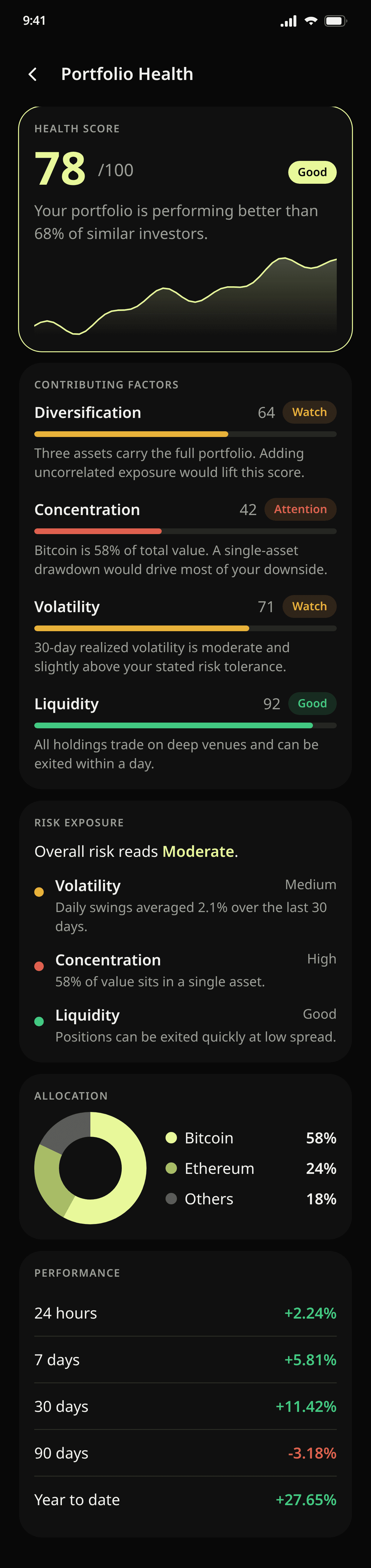
AURIC prioritizes meaningful portfolio changes over presenting every movement with equal weight. A single health score brings performance, allocation, and risk together, so users see overall condition before individual metrics.
The deeper view traces that score to its drivers — diversification, concentration, volatility, and liquidity — connecting them back to allocation and performance.
Design focus
- Prioritize meaningful signals over equal-weight data
- Make contributing risk factors visible
- Connect health, allocation, and performance
Explainable AI
Why does this matter?
AI acts as an explanation layer, not a source of automatic recommendations. When AURIC surfaces a signal, it first explains what changed and why, then lets users inspect the drivers and evidence behind that interpretation.
Confidence and evidence stay visible rather than hidden behind a single AI-generated answer, and market explanation is kept separate from personal portfolio impact.
Design focus
- Explain the change before suggesting a response
- Make evidence and confidence visible
- Connect market context to personal impact

Scenario Exploration
What could happen if I respond?
Scenario Simulation lets users explore a possible market change before deciding how to respond. Rather than a prediction, the interface frames the result as an estimate based on the portfolio's current composition and the user's assumptions.
The simulation shows how a scenario could affect value, health, risk exposure, holdings, and allocation, with the underlying reasoning kept accessible rather than treated as a black box.
Design focus
- Frame outcomes as estimates, not predictions
- Show portfolio-wide consequences of a scenario
- Keep AI reasoning available for deeper inspection

Compare Before Deciding
What changes before I make a judgment?
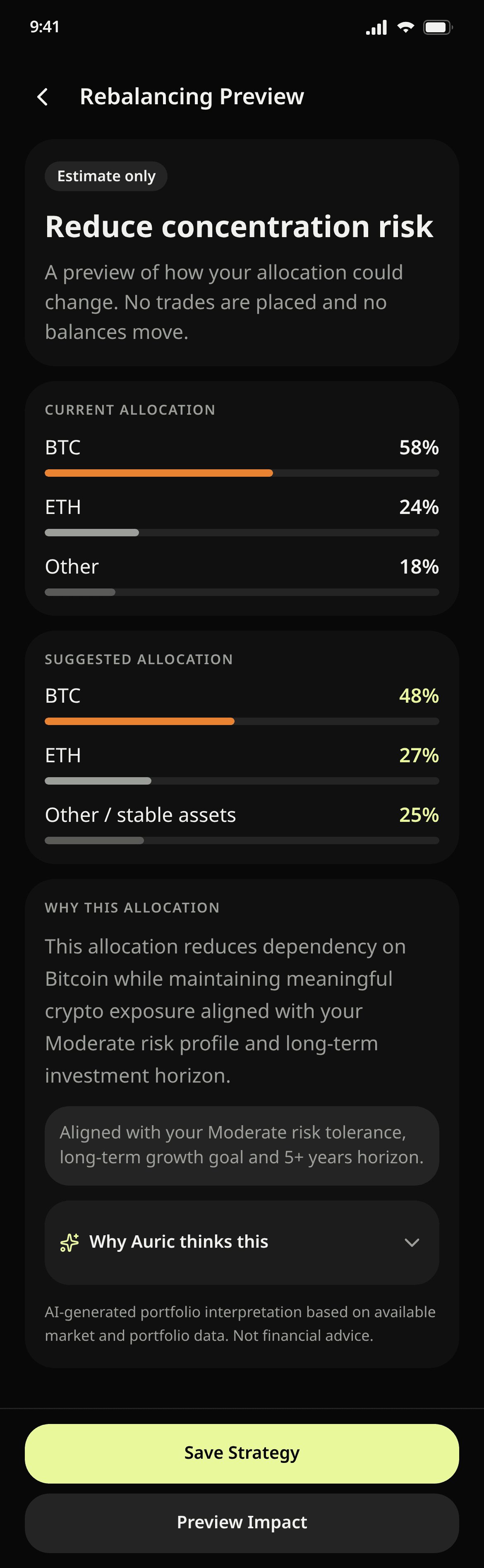
This view extends the scenario experience into exploring a possible response — comparing current allocation with a suggested alternative, and explaining how the change relates to concentration risk, risk preference, and longer-term goals.
Exploring a strategy stays separate from executing one: users can review, inspect impact, and save a proposal without placing a trade. Current and proposed states stay visible side by side so consequences remain clear.
Design focus
- Compare current and suggested allocation clearly
- Explain why the proposed change may be relevant
- Separate decision support from trade execution
Visual & Component System
AURIC is built around a restrained visual and component system designed to keep dense financial information readable and consistent across product states.
Organizing the system
Visual Hierarchy
Priority signals, confidence indicators, and financial data are weighted so the most consequential information reads first, even in a dense, numbers-heavy interface.
State & Semantic Language
Consistent color, iconography, and typography communicate confidence, risk, and status, so evidence, uncertainty, and warnings stay legible at a glance.
Reusable Components
Signal cards, an evidence and confidence module, scenario controls, and comparison panels repeat across the product with a shared visual language.
Consistency & Scale
The system was designed mobile-first, matching how self-directed investors most often check a portfolio, with patterns built to extend consistently as the product grows.
Testing the connected journey
I conducted moderated usability sessions to evaluate whether users could understand a portfolio signal, interpret the AI-supported explanation, and explore a possible response without losing context or control.
Testing setup
- Participants: 3
- Format: Moderated usability testing
- Prototype: Interactive high-fidelity app
- Focus: Hierarchy · Comprehension · Scenario clarity · User control
Tasks
- Check portfolio health.
- Investigate a priority signal.
- Review explanation and evidence.
- Evaluate a scenario.
- Review rebalancing.
01—Signal Hierarchy
Observed
Participants were unsure which portfolio change deserved attention first.
Changed
The priority hierarchy was strengthened and competing information was reduced.
Product Effect
Priority Signal becomes the clear entry point.
02—Explanation + Evidence
Observed
Participants looked for supporting evidence before trusting the explanation.
Changed
Evidence and confidence were moved closer to the AI explanation.
Product Effect
Explanation, evidence, confidence, and uncertainty now read as one connected system.
03—Scenario Framing
Observed
Some scenario outputs could be interpreted as predictions or recommendations.
Changed
Scenarios were reframed as estimates for comparison rather than expected outcomes.
Product Effect
Users can compare possibilities without treating AI output as a directive.
01—Signal Hierarchy
Observed
Participants were unsure which portfolio change deserved attention first.
Changed
The priority hierarchy was strengthened and competing information was reduced.
Product Effect
Priority Signal becomes the clear entry point.
02—Explanation + Evidence
Observed
Participants looked for supporting evidence before trusting the explanation.
Changed
Evidence and confidence were moved closer to the AI explanation.
Product Effect
Explanation, evidence, confidence, and uncertainty now read as one connected system.
03—Scenario Framing
Observed
Some scenario outputs could be interpreted as predictions or recommendations.
Changed
Scenarios were reframed as estimates for comparison rather than expected outcomes.
Product Effect
Users can compare possibilities without treating AI output as a directive.
From signal to informed decision.
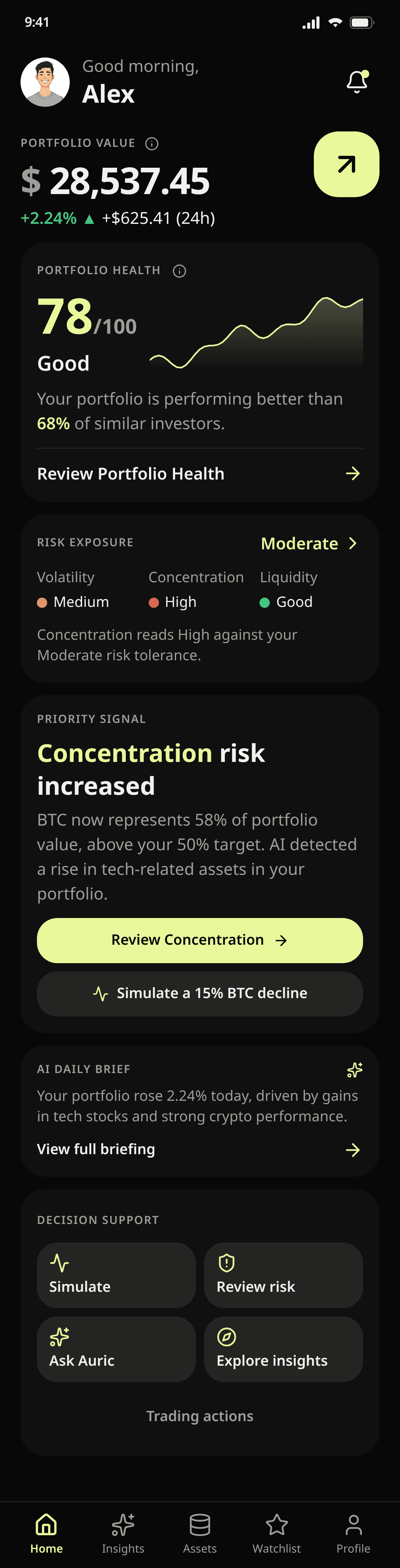
AURIC brings portfolio context, AI-assisted explanation, and scenario exploration into one continuous decision-support experience. The system helps users understand what changed, explore possible responses, and retain control over the final judgment.
Functional prototype built in Lovable.
Designing AI to support judgment, not replace it.
AURIC connects portfolio monitoring, explainable AI, and scenario exploration into one decision-support journey. AI supports interpretation while evidence, uncertainty, and final judgment remain visible to the user.
Capabilities
Product Strategy · Information Architecture · UX/UI Design · AI Interaction Patterns · Interactive Prototyping · Usability Testing
Next steps
01 — Broader Validation
Test the decision-support model with a broader range of investment experience levels and financial behaviors.
02 — Trust & AI Calibration
Explore how confidence, evidence quality, conflicting signals, and incomplete information should be communicated across different AI-assisted states.
03 — Deeper Scenario Evaluation
Evaluate how users compare multiple scenarios, interpret trade-offs, and decide when taking no action is the most appropriate outcome.